
SCUNA history » Concerts » 1970 - 1
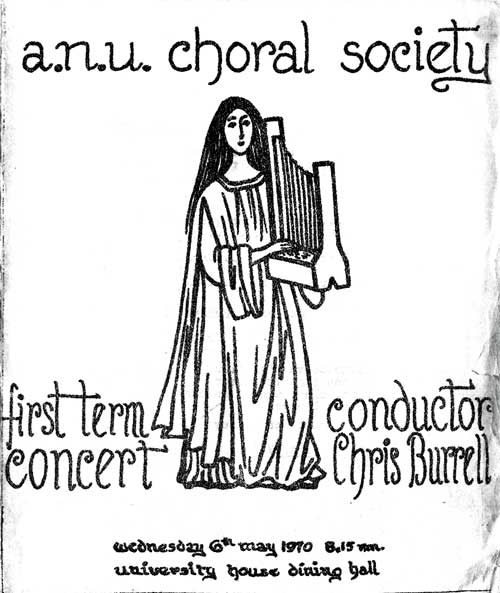
a.n.u. choral society
first term concert
conductor Chris Burrell
wednesday 6th may 1970 8.15 p.m.
university house dining hall
| 1. | Three Psalms | Jan Pieterszoon Sweelinck (1562 - 1621) | |
| i. | Seigneur, garde mon droit | ||
| ii. | De Tout mon Coeur | ||
| iii. | Incontinent que j'eu ouï | ||
| 2. | Madrigals | ||
| i. | Ce moys de may | Clément Janequin (c.1475 - c.1560) | |
| ii. | Now is the gentle season | Thomas Morley (c.1557 - 1602) | |
| iii. | Late in my rash accounting | Thomas Weelkes (c.1576 - 1623) | |
| iv. | Thus saith my Cloris bright | John Wilbye (1574 - 1638) | |
| 3. | Chansons | Francis Poulenc (1899 - 1963) | |
| i. | Margoton va-t-à l'iau | ||
| ii. | Ah, mon beau laboureur | ||
| iii. | Clic, clac, dansez sabots | ||
| iv. | Pilons l'orge | ||
INTERVAL |
|||
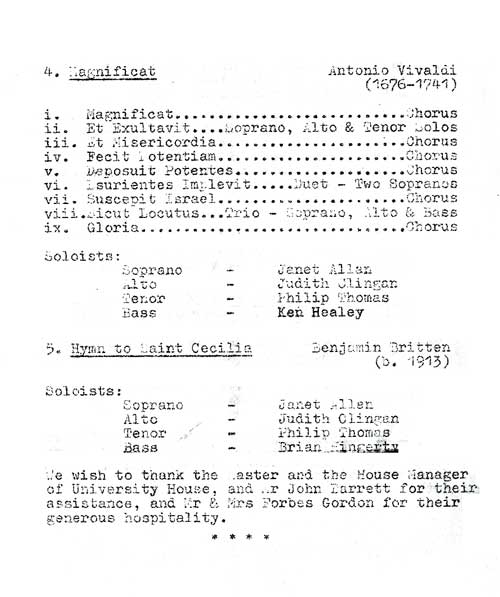
| 4. | Magnificat | Antonio Vivaldi (1676 - 1741) | ||||
| i. | Magnificat | Chorus | ||||
| ii. | Et Exsultavit | Soprano, Alto & Tenor solos | ||||
| iii. | Et Misericordia | Chorus | ||||
| iv. | Fecit Potentiam | Chorus | ||||
| v. | Deposuit Potentes | Chorus | ||||
| vi. | Esurientes Implevit | Duet - Two Sopranos | ||||
| vii. | Suscepit Israel | Chorus | ||||
| viii. | Sicut Locutus | Trio - Soprano, Alto & Bass | ||||
| ix. | Gloria | Chorus | ||||
| Soloists: | ||||||
| Soprano | - | Janet Allan | ||||
| Alto | - | Judith Clingan | ||||
| Tenor | - | Philip Thomas | ||||
| Bass | - | Ken Healey | ||||
| 5. | Hymn to Saint Cecilia | Benjamin Britten (b. 1913) | ||||
| Soloists: | ||||||
| Soprano | - | Janet Allan | ||||
| Alto | - | Judith Clingan | ||||
| Tenor | - | Philip Thomas | ||||
| Bass | - | Brian Hingerty | ||||
We wish to thank the Master and the House Manager of University House, and Mr John Barrett for their assistance, and Mr & Mrs Forbes Gordon for their generous hospitality.
* * * * * *
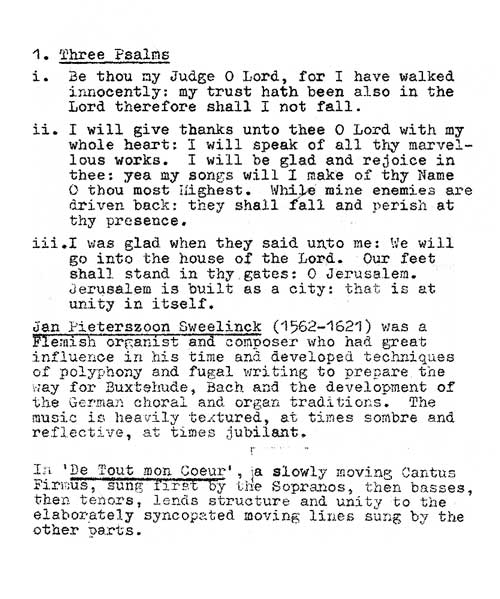
Jan Pieterszoon Sweelinck (1562-1621) was a Flemish organist and composer who had great influence in his time and developed techniques of polyphony and fugal writing to prepare the way for Buxtehude, Bach and the development of the German choral and organ traditions. The music is heavily textured, at times sombre and reflective, at times jubilant.
In 'De Tout mon Coeur', a slowly moving Cantus Firmus, sung first by the Sopranos, then basses, then tenors, lends structure and unity to the elaborately syncopated moving lines sung by the other parts.
Missing - presumably contained more info about the Sweelinck psalms
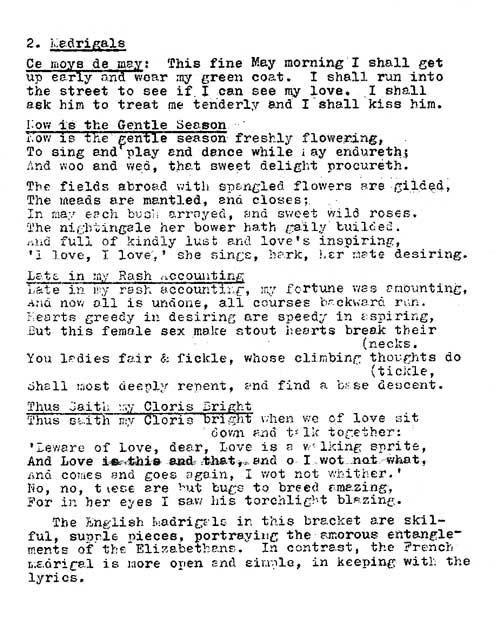
Ce moys de may: This fine May morning I shall get up early and wear my green coat. I shall run into the street to see if I can see my love. I shall ask him to treat me tenderly and I shall kiss him.
Now is the gentle season
Now is the gentle season freshly flowering,
To sing and play and dance while May endureth;
And woo and wed, that sweet delight procureth.
The fields abroad with spangled flowers are gilded,
The meads are mantled, and closes:
In may each bush arrayed, and sweet wild roses.
The nightingale her bower hath gaily builded.
And full of kindly lust and love's inspiring,
'I love, I love,' she sings, hark, her mate desiring.
Late in my rash accounting
Late in my rash accounting, my fortune was amounting,
And now all is undone, all courses backward run.
Hearts greedy in desiring are speedy in aspiring,
But this female sex makes stout hearts break their necks.
You ladies fair and fickle, whose climbing thoughts do tickle,
Shall most deeply repent, and find a base descent.
Thus saith my Cloris bright
Thus saith my Cloris bright when we of love sit down and talk together:
'Beware of love, dear, Love is a walking sprite,
And love is this and that, and o I wot not what,
And comes and goes again, I wot not whither.'
No, no, these are but bugs to breed amazing,
For in her eyes I saw his torchlight blazing.
The English madrigals in this bracket are skilful, supple pieces, portraying the amorous entanglements of the Elizabethans. In contrast, the French madrigal is more open and simple, in keeping with the lyrics.
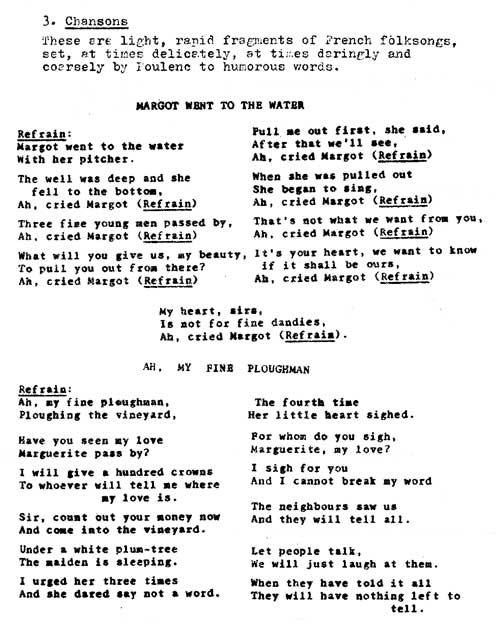
These are light, rapid fragments of French folksongs, set, at times delicately, at times daringly and coarsely, by Poulenc to humorous words.
MARGOT WENT TO THE WATER
Refrain:
Margot went to the water
With her pitcher.
The well was deep and she fell to the bottom,
Ah! cried Margot (Refrain)
Three fine young men passed by,
Ah! cried Margot (Refrain)
What will you give us, my beauty,
To pull you out from there?
Ah! cried Margot (Refrain)
Pull me out first, she said,
After that we'll see.
Ah! cried Margot (Refrain)
When she was pulled out
She began to sing.
Ah! cried Margot (Refrain)
That's not what we want from you,
Ah! cried Margot (Refrain)
It's your heart, we want to know if it shall be ours,
Ah! cried Margot (Refrain)
My heart, sirs,
Is not for fine dandies,
Ah! cried Margot (Refrain)
AH! MON BEAU LABOUREUR
Refrain:
Ah, my fine ploughman,
Ploughing the vineyard.
Have you seen my love
Marguerite pass by?
I will give a hundred crowns
To whoever will tell me where my love is.
Sir, count out your money now
And come into the vineyard.
Under a white plum-tree
The maiden is sleeping.
I urged her three times
And she dared not say a word.
The fourth time
Her little heart sighed.
For whom do you sigh,
Marguerite, my love?
I sigh for you
And I cannot break my word.
The neighbours saw us
And they will tell all.
Let people talk,
We will just laugh at them.
When they have told it all
They'll have nothing left to tell.
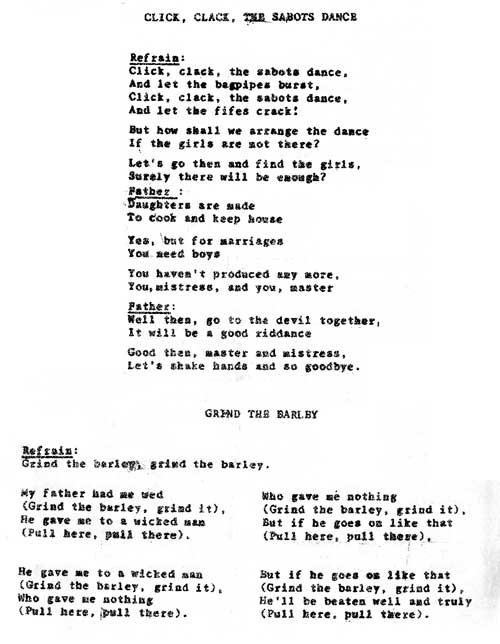
CLICK, CLACK, THE SABOTS DANCE
Refrain:
Click, clack, the sabots dance,
And let the bagpipes burst,
Click, clack, the sabots dance,
And let the fifes crack!
But how shall we arrange the dance
If the girls are not there?
Let's go then and find the girls. Surely there will be enough?
Father: Daughters are made
To cook and keep house.
Yes, but for marriages
You need boys.
You haven't produced any more,
You, mistress, and you, master.
Father: Well then, go to the devil together,
It will be a good riddance.
Good then, master and mistress,
Let's shake hands and so goodbye.
GRIND THE BARLEY
Refrain:
Grind the barley, grind the barley.
My father had me wed
(Grind the barley, grind it),
He gave me to a wicked man
(Pull here, pull there).
He gave me to a wicked man
(Grind the barley, grind it),
Who gave me nothing
(Pull here, pull there).
Who gave me nothing
(Grind the barley, grind it),
But if he goes on like that
(Pull here, pull there).
But if he goes on like that
(Grind the barley, grind it),
He'll be beaten well and truly
(Pull here, pull there).
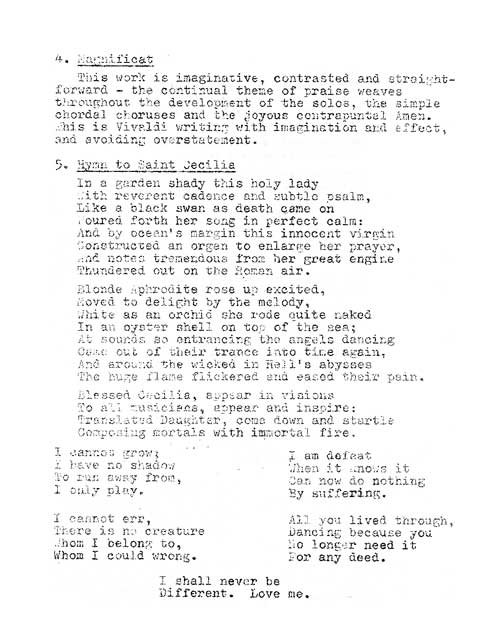
This work is imaginative, contrasted and straightforward - the continual theme of praise weaves throughout the development of the solos, the simple chordal choruses and the joyous contrapuntal Amen. This is Vivaldi writing with imagination and effect, and avoiding overstatement.
In a garden shady this holy lady
With reverent cadence and subtle psalm,
Like a black swan as death came on
Poured forth her song in perfect calm;
And by ocean's margin this innocent virgin
Constructed an organ to enlarge her prayer,
And notes tremendous from her great engine
Thundered out on the Roman air.
Blonde Aphrodite rose up excited,
Moved to delight by the melody,
White as an orchid she rode quite naked
In an oyster shell on top of the sea;
At sounds so entrancing the angels dancing
Came out of their trance into time again,
And around the wicked in Hell's abysses
The huge flame flickered and eased their pain.
I cannot grow;
I have no shadow
To run away from,
I only play.
I cannot err,
There is no creature
Whom I belong to,
Whom I could wrong.
I am defeat
When it knows it
Can now do nothing
By suffering.
All you lived through
Dancing because you
No longer need it
For any deed.
I shall never be different. Love me.
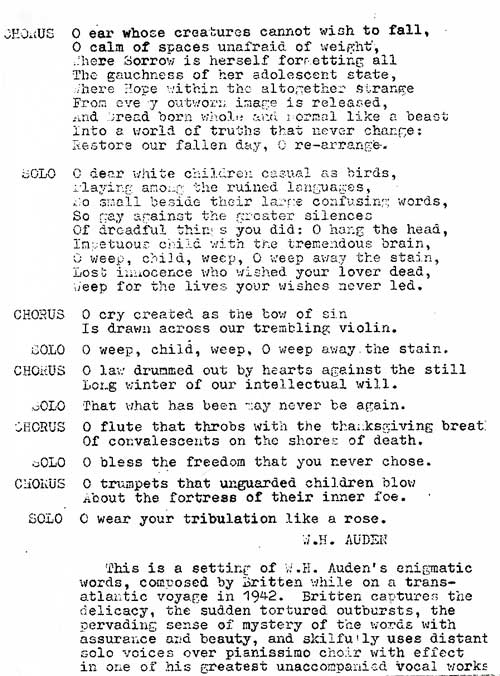
CHORUS
O ear whose creatures cannot wish to fall,
O calm of spaces unafraid of weight,
Where Sorrow is herself forgetting all
The gaucheness of her adolescent state,
Where Hope within the altogether strange
From every outworn image is released,
And Dread born whole and normal like a beast
Into a world of truths that never change:
Restore our fallen day, O re-arrange.
SOLO
O dear white children, casual as birds,
Playing among the ruined languages,
So small beside their large confusing words,
So gay against the greater silences
Of dreadful things you did: O hang the head,
Impetuous child with the tremendous brain,
O weep, child, weep, O weep away the stain,
Lost innocence who wished your lover dead,
Weep for the lives your wishes never led.
CHORUS
O cry created as the bow of sin
Is drawn across our trembling violin.
SOLO
O weep, child, weep, O weep away the stain.
CHORUS
O law drummed out by hearts against the still
Long winter of our intellectual will.
SOLO
That what has been may never be again.
CHORUS
O flute that throbs with the thanksgiving breath
Of convalescents on the shores of death.
SOLO
O bless the freedom that you never chose.
CHORUS
O trumpets that unguarded children blow
About the fortress of their inner foe.
SOLO
O wear your tribulation like a rose.
W.H. AUDEN
This is a setting of W.H. Auden's enigmatic words, composed by Britten while on a trans-atlantic voyage in 1942. Britten captures the delicacy, the sudden tortured outbursts, the pervading sense of mystery of the words with assurance and beauty, and skilfully uses distant solo voices over pianissimo choir with effect in one of his greatest unaccompanied vocal works.
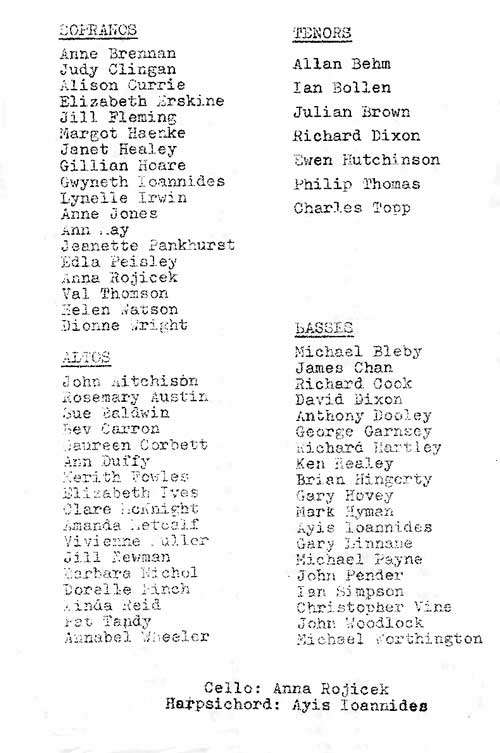
| SOPRANOS Anne Brennan Judy Clingan Alison Currie Elizabeth Erskine Jill Fleming Margot Haenke Janet Healey Gillian Hoare Gwyneth Ioannides Lynelle Irwin Anne Jones Ann May Jeanette Pankhurst Edla Peisley Anna Rojicek Val Thomson Helen Watson Dionne Wright |
TENORS Allan Behm Ian Bollen Julian Brown Richard Dixon Ewen Hutchinson Philip Thomas Charles Topp |
| ALTOS John Aitchison Rosemary Austin Sue Baldwin Bev Carron Maureen Corbett Ann Duffy Kerith Fowles Elizabeth Ives Clare McKnight Amanda Metcalf Vivienne Muller Jill Newman Barbara Nichol Dorelle Pinch Linda Reid Pat Tandy Annabel Wheeler |
BASSES Michael Bleby James Chan Richard Cook David Dixon Anthony Dooley George Garnsey Richard Hartley Ken Healey Brian Hingerty Gary Hovey Mark Hyman Ayis Ioannides Gary Linnane Michael Payne John Pender Ian Simpson Christopher Vine John Woodlock Michael Worthington |
Cello: Anna Rojicek
Harpsichord: Ayis Ioannides
1This page is a reconstruction. I scanned this programme on the day of the SCUNA 40th reunion dinner, and in my haste made some mistakes. When I get my hands on this programme again, I'll make an accurate scan and correct this page!
2Another missing page - to be added when possible.