
SCUNA history » Concerts » 1972 - 2
On this page: Advertisement | Programme
The A.N.U. Choral Society
presents
8.15 p.m., July 30. In the University House Dining Hall
Works include Purcell's "King Arthur", Motets by Tos[sic - should be Jos]quin, Choral dances from Britten's "Gloriana"
Tickets at door. Adults $1.50, students 80c.
Source: Advertising. (1972, July 29). The Canberra Times (ACT : 1926 - 1995), p. 14. Retrieved May 17, 2013, from Trove: http://nla.gov.au/nla.news-article101996753
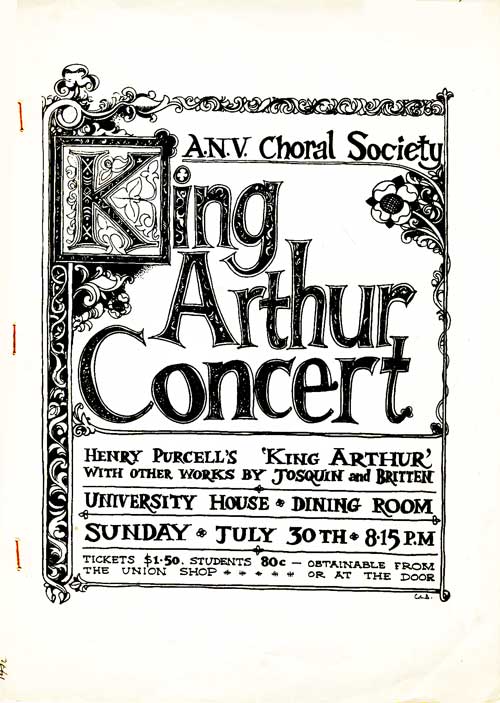
ANU Choral Society
King Arthur Concert
Henry Purcell's 'King Arthur'
with other works by Josquin and Britten
University House Dining Room
Sunday July 30th 8.15 p.m
Tickets $1.50. Students 80c - obtainable from
the Union Shop or at the door
| PROGRAMME | |||||
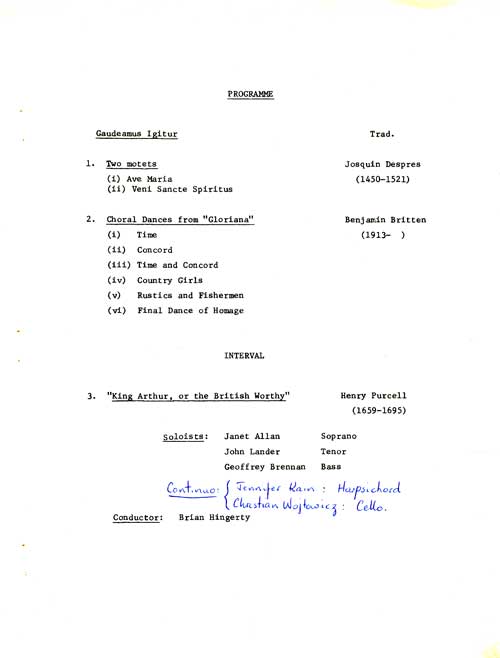
| Gaudeamus Igitur | Trad. | ||||
| 1. | Two motets: | Josquin Despres (1450-1521) |
|||
| (i) | Ave Maria | ||||
| (ii) | Veni Sancte Spiritus | ||||
| 2. | Choral Dances from "Gloriana" | Benjamin Br1tten (1913- ) |
|||
| (i) | Time | ||||
| (ii) | Concord | ||||
| (iii) | Time and Concord | ||||
| (iv) | Country Girls | ||||
| (v) | Rustics and Fishermen | ||||
| (vi) | Final Dance of Homage | ||||
| INTERVAL | |||||
| 2. | "King Arthur, or the British Worthy" | Henry Purcell (1659-1695) |
|||
| Soloists: | Janet Allan | Soprano | |||
| John Lander | Tenor | ||||
| Geoffrey Brennan | Bass | ||||
| Continuo*: | Jennifer Kain | Harpsichord | |||
| Christian Wojtowicz | Cello | ||||
| Conductor: | Brian Hingerty | ||||
1. Two Motets Josquin Despres
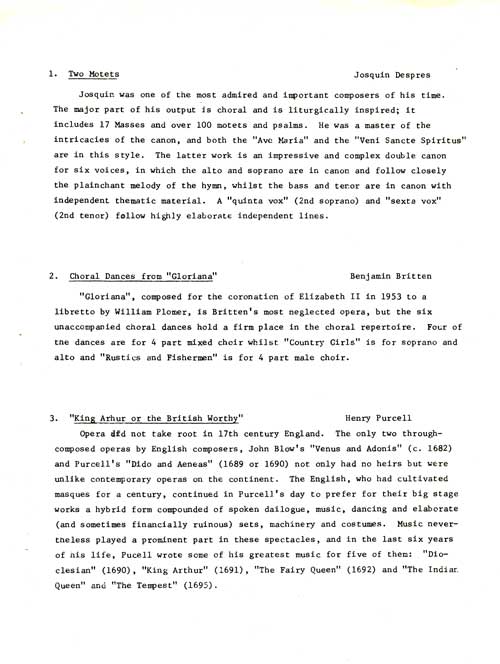
Josquin was one of the most admired and important composers of his time. The major part of his output is choral and is liturgicaliy inspired; it includes 17 Masses and over 100 motets and psalms. He was a master of the intricacies of the canon, and both the "Ave Maria" and the "Veni Sancte Spiritus" are in this styie. The latter work is an impressive and complex double canon for six voices, in which the alto and soprano are in canon and follow closely the plainchant melody of the hymn, whilst the bass and tenor are in canon with independent thematic material. A "quinta vox" (2nd soprano) and "sexta vox" (2nd tenor) follow highly elaborate independent lines.
2. Choral Dances from "Gloriana" Benjamin Britten
"Gloriana", composed for the coronation af Elizabeth II in 1953 to a libretto by William Plomer, is Britten's most neglected opera, but the six unaccompanied choral dances hold a firm place in the choral repertoire. Four of the dances are for 4 part mixed choir whilst "Country Girls" is for soprano and alto and "Rustics and Fishermen" is for 4 part male choir.
3. "King Arthur or the British Worthy" Henry Purcell
Opera did not take root in 17th century England. The only two through-composed operas by English composers, John Blow's "Venus and Adonis" (c. 1682) and Purcell's "Dido and Aeneas" (1689 or 1690) not only had no heirs but were unlike contemporary operas on the continent. The English, who had cultivated masques for a century, continued in Purcell's day to prefer for their big stage works a hybrid form compounded of spoken dialogue, music, dancing and elaborate (and sometimes financially ruinous) sets, machinery and costumea. Music nevertheless played a prominent part in these spectacles, and in the last six years of his life, Purcell wrote some of his greatest music for five of them: "Dioclesian" (1690), "King Arthur" (1691), "The Fairy Queen" (1692) and "The Indian Queen" and "The Tempest" (1695).
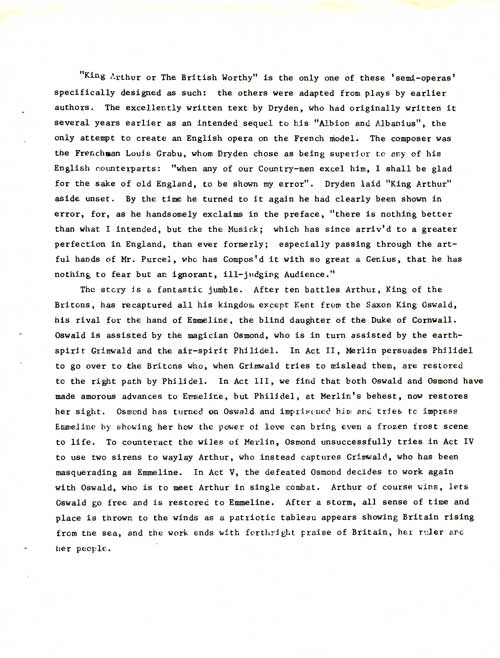
"King Arthur or The British Worthy" is the only one of these 'semi-operas' specifically designed as such: the others were adapted from plays by earlier authors. The excellently written text by Dryden, who had originally written it several years earlier as an intended sequel to his "Albion and Albanius", the only attempt to create an English opera on the French model. The composer was the Frenchman Louis Grabu, whom Dryden chose as being superior to any of his English counterparts: "when any of our Country-men excel him, I shall be glad for the sake of old England, to be shown my error". Dryden laid "King Arthur" aside unset. By the time he turned to it again he had clearly been shown in error, for, as he handsomely exclaims in the preface, "there is nothing better than what I intended, but the Musick; which has since arriv'd to a greater perfection in England, than ever formerly; especially passing through the artful hands of Mr. Purcel, who has Compos'd it with so great a Genius, that he has nothing to fear but an ignorant, ill-judging Audience."
The story is a fantastic jumble. After ten battles Arthur, King of the Britons, has recaptured all his kingdom except Kent from the Saxon King Oswald, his rival for the hand of Emmeline, the blind daughter of the Duke of Cornwall. Oswald is assisted by the magician Osmond, who is in turn assisted by the earth-spirit Grimwald and the air-spirit Philidel. In Act II, Merlin persuades Philidel to go over to the Britons who, when Grimwald tries to mislead them, are restored to the right path by Philidel. In Act III, we find that both Oswald and Osmond have made amorous advances to Emmeline, but Philidel, at Merlin's behest, now restores her sight. Osmond has turned on Oswa1d and imprisoned him and tries to impress Emmeline by showing her how the power of love can bring even a frozen frost scene to life. To counteract the wiles of Merlin, Osmond unsucessfully tries in Act IV to use two sirens to waylay Arthur, who instead captures Griwald, who has been masquerading as Emmeline. In Act V, the defeated Osmond decides to work again with Oswald, who is to meet Arthur in single combat. Arthur of course wins, lets Oswald go free and is restored to Emmeline. After a storm, all sense of time and place is thrown to the winds as a patriotic tableau appears showing Britain rising from the sea, and the work ends with forthright praise of Britain, her ruler and her people.
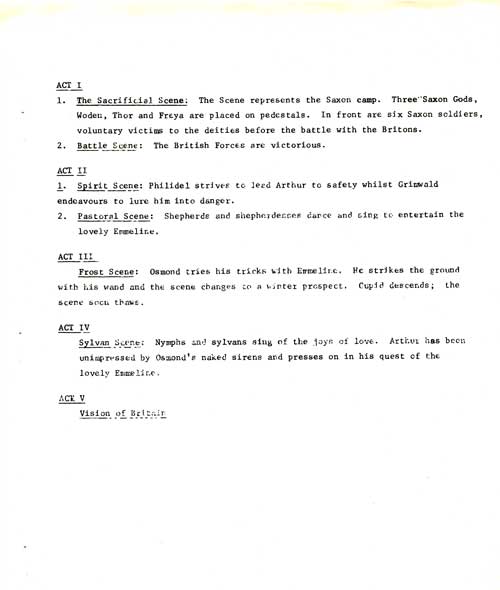
ACT I
ACT II
ACT III
Frost Scene: Osmond tries his tricks with Emmeline. He strikes the ground with his wand and the scene changes to a winter prospect. Cupid descends; the scene soon thaws.
ACT IV
Sylvan Scene: Nymphs and sylvans sing of the joys of love. Arthur has been unimpressed by Osmond's naked sirens and presses on in his quest of the lovely Emmeline.
ACT V
Vision of Britain
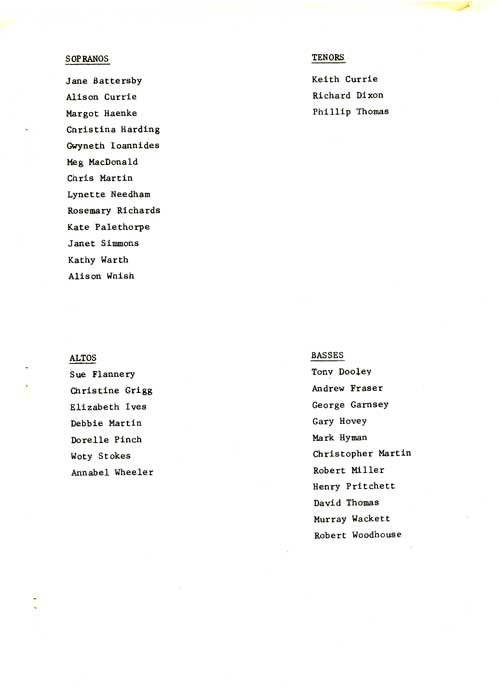
| SOPRANOS | TENORS |
| Jane Battersby Alison Currie Margot Haenke Christina Harding Gwyneth Ioannides Meg MacDonald Chris Martin Lynette Needham Rosemary Richards Kate Palethorpe Janet Simmons Kathy Warth Alison Whish |
Keith Currie Richard Dixon Phillip Thomas |
| ALTOS | BASSES |
| Sue Flannery Christine Grigg Elizabeth Ives Debbie Martin Dorelle Pinch Woty Stokes Annabel Wheeler |
Tony Dooley Andrew Fraser George Garnsey Gary Hovey Mark Hyman Christopher Martin Robert Miller Henry Pritchett David Thomas Murray Wackett Robert Woodhouse |
*Continuo details in Brian Hingerty's handwriting.