
SCUNA history » Concerts » 1976 - 3
Publicity | Programme | Programme Supplement
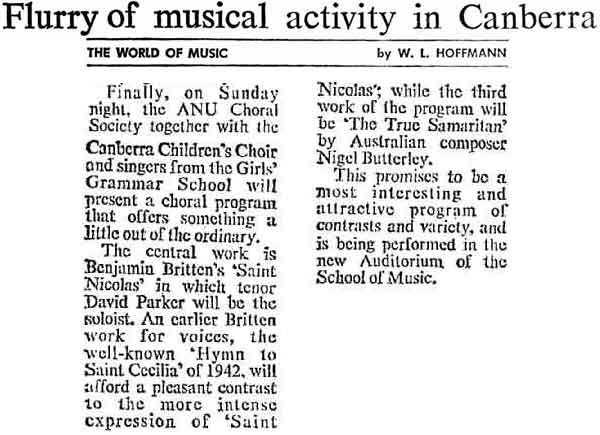
THE WORLD OF MUSIC by W. L. HOFFMANN [Excerpt]
Finally, on Sunday night, the ANU Choral Society together with the Canberra Children's Choir and singers from the Girls' Grammar School will present a choral program that offers something a little out of the ordinary.
The central work is Benjamin Britten's 'Saint Nicolas' in which tenor David Parker will be the soloist. An earlier Britten work for voices, the well-known 'Hymn to Saint Cecilia' of 1942, will afford a pleasant contrast to the more intense expression of 'Saint Nicolas'; while the third work of Ihc program will be 'The True Samaritan' by Australian composer Nigel Butterley.
This promises to be a most interesting and attractive program of contrasts and variety, and is being performed in the new Auditorium of the School of Music.
Source: Flurry of musical activity in Canberra. (1976, October 28). The Canberra Times (ACT : 1926 - 1995), p. 25. Retrieved June 21, 2013, from Trove: http://nla.gov.au/nla.news-article110832457
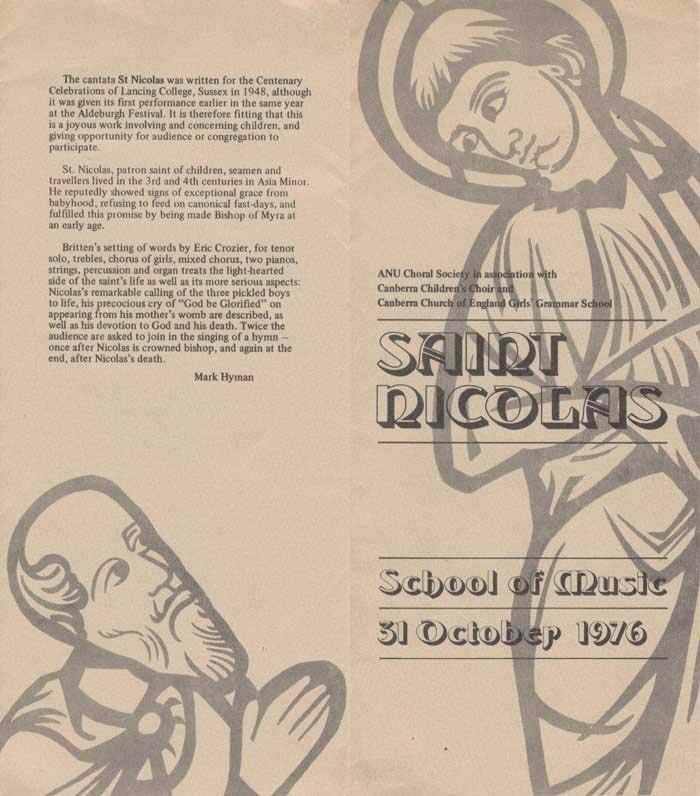
ANU Choral Society in association with
Canberra Children's Choir and
Canberra Church of England Girls' Grammar School
SAINT NICOLAS
School of Music
31 October 1976
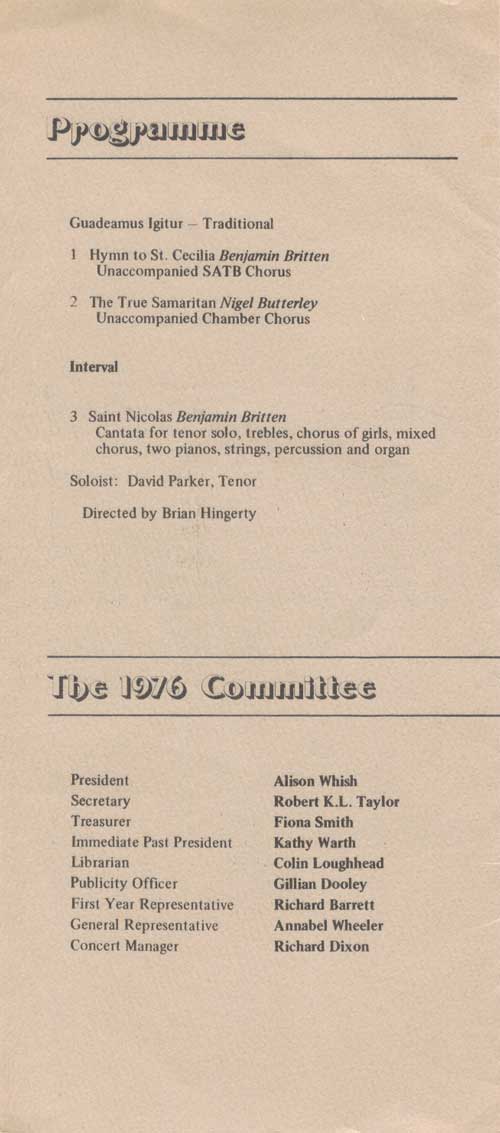
Gaudeamus Igitur - Traditional
Interval
Soloist: David Parker, Tenor
| President | Alison Whish |
| Secretary | Robert K.L. Taylor |
| Treasurer | Fiona Smith |
| Immediate Past President | Kathy Warth |
| Librarian | Colin Loughhead |
| Publicity Officer | Gillian Dooley |
| First Year Rep | Richard Barrett |
| General Rep | Annabel Wheeler |
| Concert Manager | Richard Dixon |
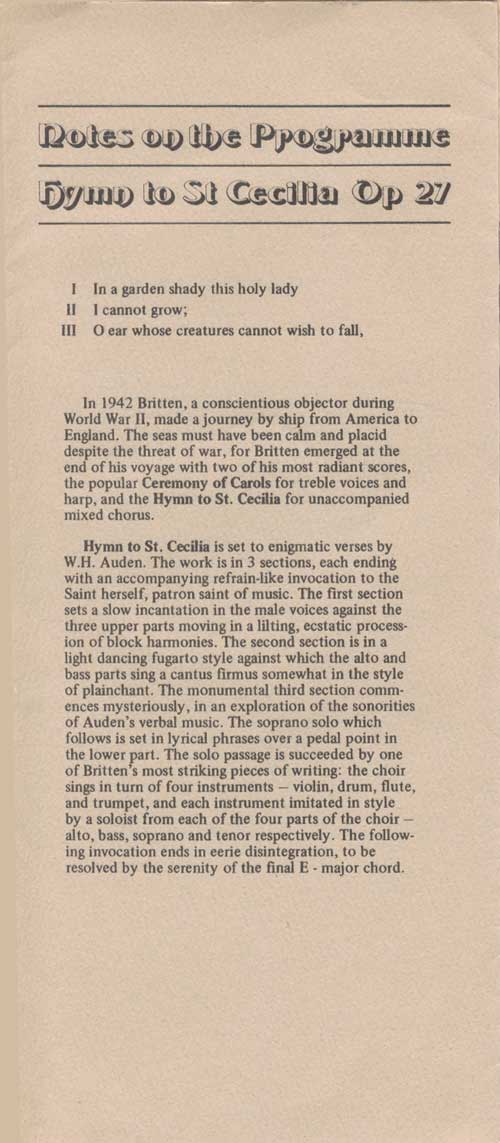
The words to the Hymn to St Cecilia appear in the Programme Supplement below.
In 1942 Britten, a conscientious objector during World War II, made a journey by ship from America to England. The seas must have been calm and placid despite the threat of war, for Britten emerged at the end of his voyage with two of his most radiant scores, the popular Ceremony of Carols for treble voices and harp, and the Hymn to St. Cecilia for unaccompanied mixed chorus.
Hymn to St. Cecilia is set to enigmatic verses by W.H. Auden. The work is in 3 sections, each ending with an accompanying refrain-like invocation to the Saint herself, patron saint of music. The first section sets a slow incantation in the male voices against the three upper parts moving in a lilting, ecstatic procession of block harmonies. The second section is in a light dancing fugato style against which the alto and bass parts sing a cantus firmus somewhat in the style of plainchant. The monumental third section commences mysteriously, in an exploration of the sonorities of Auden's verbal music. The soprano solo which follows is set in lyrical phrases over a pedal point in the lower part. The solo passage is succeeded by one of Britten's most striking pieces of writing: the choir sings in turn of four instruments - violin, drum, flute, and trumpet, and each instrument imitated in style by a soloist from each of the four parts of the choir - alto, bass, soprano and tenor respectively. The following invocation ends in eerie disintegration, to be resolved by the serenity of the final E-major chord.
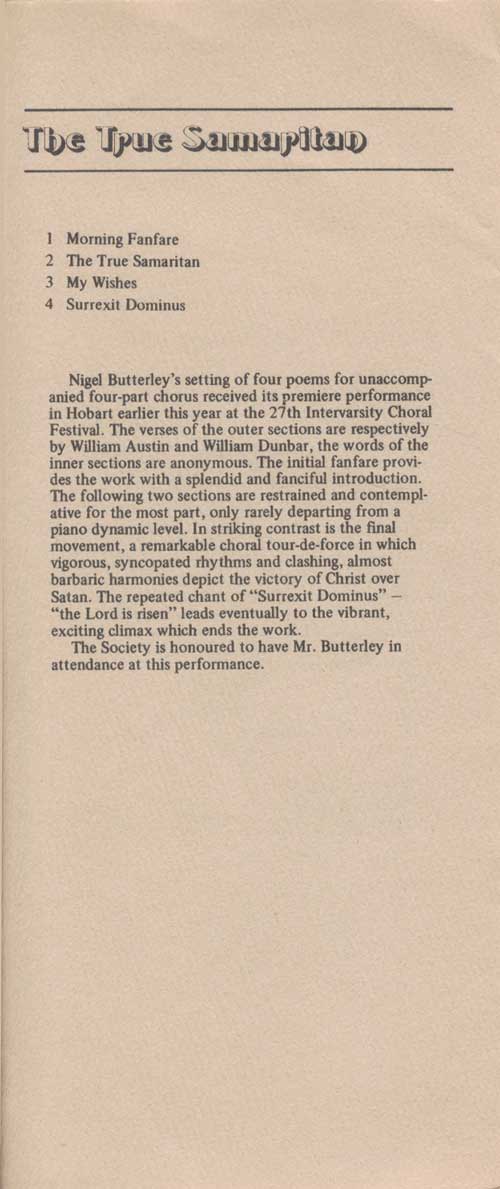
Further information, and the words to the True Samaritan, appear in the Programme Supplement below.
Nigel Butterley's setting of four poems for unaccompanied four-part chorus received its premiere performance in Hobart earlier this year at the 27th Intervarsity Choral Festival. The verses of the outer sections are respectively by William Austin and William Dunbar, the words of the inner sections are anonymous. The initial fanfare provides the work with a splendid and fanciful introduction. The following two sections are restrained and contemplative for the most part, only rarely departing from a piano dynamic level. In striking contrast is the final movement, a remarkable choral tour-de-force in which vigorous, syncopated rhythms and clashing, almost barbaric harmonies depict the victory of Christ over Satan. The repeated chant of "Surrexit Dominus" - "the Lord is risen" leads eventually to the vibrant, exciting climax which ends the work.
The Society is honoured to have Mr. Butterley in attendance at this performance.
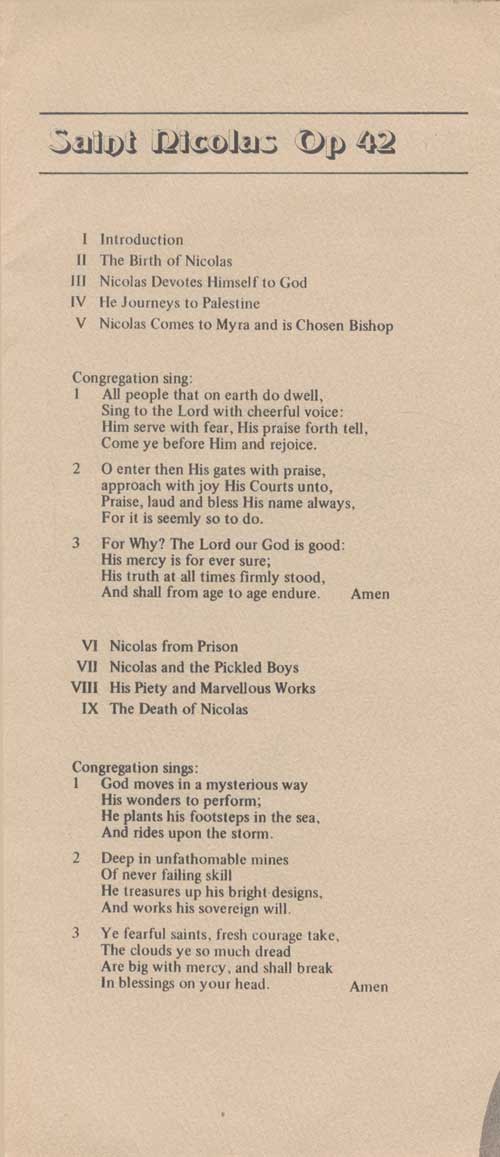
Congregation sing:
Congregation sings:
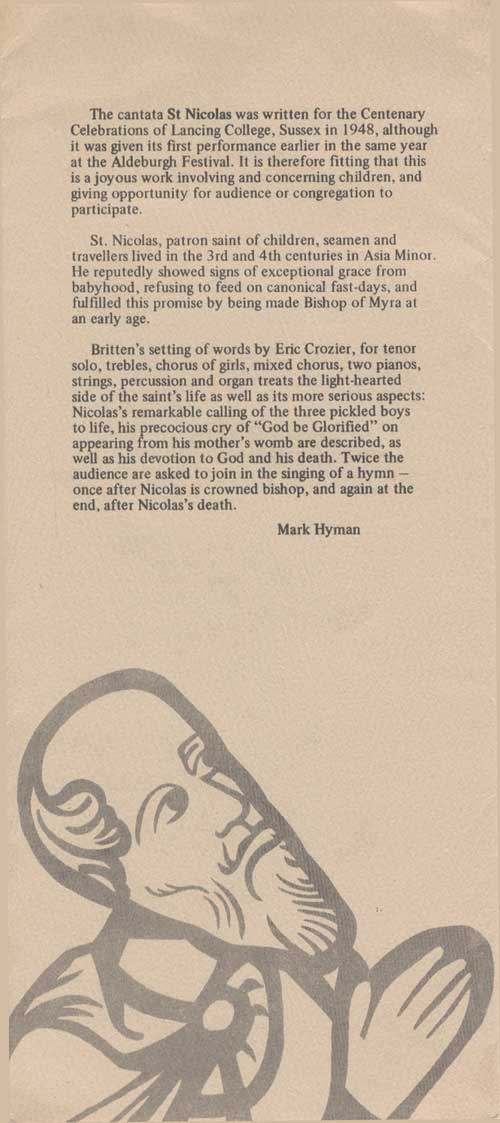
The cantata St Nicolas was written for the Centenary Celebrations of Lancing College, Sussex in 1948, although it was given its first performance earlier in the same year at the Aldeburgh Festival. It is therefore fitting that this is a joyous work involving and concerning children, and giving opportunity for audience or congregation to participate.
St. Nicolas, patron saint of children, seamen and travellers lived in the 3rd and 4th centuries in Asia Minor. He reputedly showed signs of exceptional grace from babyhood, refusing to feed on canonical fast-days, and fulfilled this promise by being made Bishop of Myra at an early age.
Britten's setting of words by Eric Crozier, for tenor solo, trebles, chorus of girls, mixed chorus, two pianos, strings, percussion and organ treats the light-hearted side of the saint's life as well as its more serious aspects: Nicolas's remarkable calling of the three pickled boys to life, his precocious cry of "God be Glorified" on appearing from his mother's womb are described, as well as his devotion to God and his death. Twice the audience are asked to join in the singing of a hymn - once after Nicolas is crowned bishop, and again at the end, after Nicolas's death.
Mark Hyman
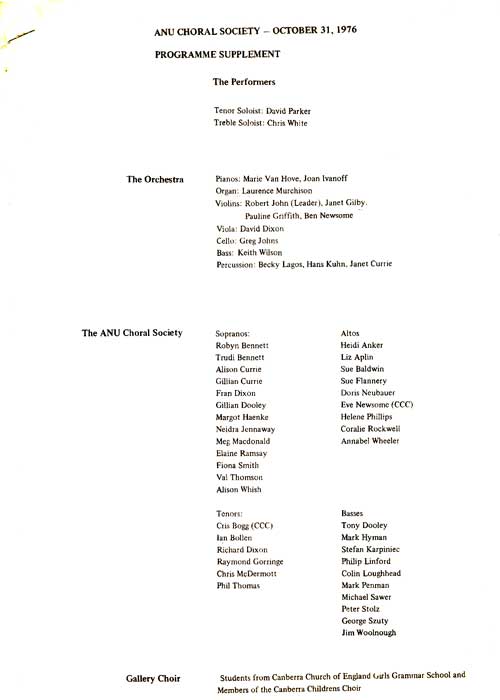
| The Performers | Tenor Soloist: | David Parker |
| Treble Soloist: | Chris White | |
| The Orchestra | Pianos: | Marie Van Hove, Joan Ivanoff |
| Organ: | Laurence Murchison | |
| Violins: | Robert John (Leader), Janet Gilby, Pauline Griffith, Ben Newsome | |
| Viola: | David Dixon | |
| Cello: | Greg Johns | |
| Bass: | Keith Wilson | |
| Percussion: | Becky Lagos, Hans Kuhn, Janet Currie | |
| The ANU Choral Society | Sopranos: Robyn Bennett Trudi Bennett Alison Currie Gillian Currie Fran Dixon Gillian Dooley Margot Haenke Neidra Jennaway Meg MacDonald Elaine Ramsay Fiona Smith Val Thomson Alison Whish |
Altos: Heidi Anker Liz Aplin Sue Baldwin Sue Flannery Doris Neubauer Eve Newsome (CCC) Helene Phillips Coralie Rockwell Annabel Wheeler |
|
Tenors: Cris Bogg (CCC) Ian Bollen Richard Dixon Raymond Gorringe Chris McDermott Phil Thomas |
Basses: Tony Dooley Mark Hyman Stefan Karpiniec Philip Linford Colin Loughhead Mark Penman Michael Sawer Peter Stolz George Szuty Jim Woolnough |
|
| Gallery Choir | Students from Canberra Church of England Girls Grammar School and Members of the Canberra Childrens Choir | |
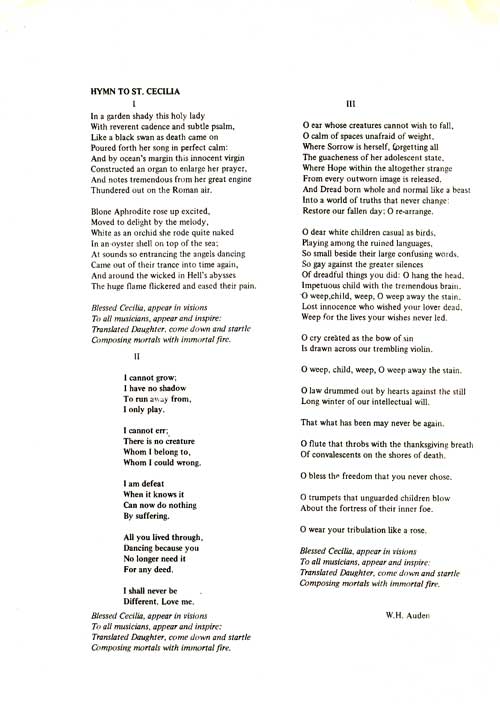
I
In a garden shady this holy lady
With reverent cadence and subtle psalm,
Like a black swan as death came on
Poured forth her song in perfect calm:
And by ocean's margin this innocent virgin
Constructed an organ to enlarge her prayer,
And notes tremendous from her great engine
Thundered out on the Roman air.
Blonde Aphrodite rose up excited,
Moved to delight by the melody,
White as an orchid she rode quite naked
In an oyster shell on top of the sea;
At sounds so entrancing the angels dancing
Came out of their trance into time again,
And around the wicked in Hell's abysses
The huge flame flickered and eased their pain.
Blessed Cecilia, appear in visions
To all musicians, appear and inspire:
Translated Daughter, come down and startle
Composing mortals with immortal fire.
II
I cannot grow,
I have no shadow
To run away from,
I only play.
I cannot err,
There is no creature
Whom I belong to,
Whom I could wrong.
I am defeat
When it knows it
Can now do nothing
By suffering.
All you lived through,
Dancing because you
No longer need it
For any deed.
I shall never be
Different. Love me.
Blessed Cecilia, appear in visions
To all musicians, appear and inspire:
Translated Daughter, come down and startle
Composing mortals with immortal fire.
III
0 ear whose creatures cannot wish to fall,
0 calm of spaces unafraid of weight,
Where Sorrow is herself, forgetting all
The gaucheness of her adolescent state,
Where Hope within the altogether strange
From every outworn image is released.
And Dread born whole and normal like a beast
Into a world of truths that never change:
Restore our fa1len day; 0 re-arrange.
0 dear white children casual as birds,
Playing among the ruined languages,
So small beside their large confusing words.
So gay against the greater silences
Of dreadful thing you did: 0 hang the head,
Impetuous child with the tremendous brain.
0 weep, child, weep, 0 weep away the stain.
Lost innocence who wished your lover dead.
Weep for the lives your wishes never led.
0 cry created as the bow of sin
Is drawn across our trembling violin.
0 weep, child, weep, 0 weep away the stain.
0 law drummed out by hearts against the still
Long winter of our intellectual will.
That what has been may never be again.
0 flute that throbs with the thanksgiving breath
Of convalescents on the shores of death.
0 bless the freedom that you never chose.
0 trumpets that unguarded children blow
About the fortress of their inner foe.
0 wear your tribulation like a rose.
Blessed Cecilia, appear in visions
To all musicians, appear and inspire:
Translated Daughter, come down and startle
Composing mortals with immortal fire.
W.H. Auden
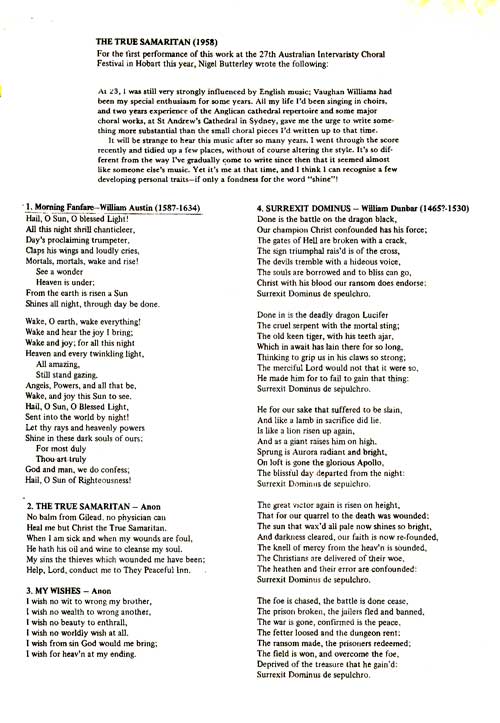
For the first performance of this work at the 27th Australian Intervarsity Choral Festival in Hobart this year, Nigel Butterley wrote the following:
At 23, I was still very strongly influenced by English music; Vaughan Williams had been my special enthusiasm for some years. All my life I'd been singing in choirs, and two years experience of the Anglican cathedral repertoire and some major choral works, at St Andrew's Cathedral in Sydney, gave me the urge to write something more substantial than the small choral pieces I'd written up to that time.
It will be strange to hear this music after so many years. I went through the score recently and tidied up a few places, without of course altering the style. It's so different from the way I've gradually come to write since then that it seemed almost like someone else's music. Yet it's me at that time, and I think I can recognise a few developing personal traits - if only a fondness for the word "shine"!
Hail, 0 Sun, 0 blessed Light!
All this night shrill chanticleer,
Day's proclaiming trumpeter,
Claps his wings and loudly cries,
Mortals, mortals, wake and rise!
See a wonder
Heaven is under;
From the earth is risen a Sun
Shines all night, though day be done.
Wake, 0 earth, wake everything!
Wake and hear the joy I bring;
Wake and joy; for all this night
Heaven and every twinkling light,
All amazing,
Still stand gazing.
Angels, Powers, and all that be,
Wake, and joy this Sun to see,
Hail, 0 Sun, 0 Blessed Light,
Sent into the world by night!
Let thy rays and heavenly powers
Shine in these dark souls of ours;
For most duly
Thou art truly
God and man, we do confess;
Hail, 0 Sun of Righteousness!
No balm from Gilead, no physician can
Heal me but Christ the True Samaritan.
When I am sick and when my wounds are foul,
He hath his oil and wine to cleanse my soul.
My sins the thieves which wounded me have been;
Help, Lord, conduct me to Thy Peaceful Inn.
I wish no wit to wrong my brother,
I wish no wealth to wrong another,
I wish no beauty to enthrall,
I wish no worldly wish at all.
I wish from sin God would me bring;
I wish for heav'n at my ending.
Done is the battle on the dragon black,
Our champion Christ confounded has his force;
The gates of Hell are broken with a crack,
The sign triumphal rais'd is of the cross,
The devils tremble with a hideous voice,
The souls are borrowed and to bliss can go,
Christ with his blood our ransom does endorse;
Surrexit Dominus de sepulchro.
Done in is the deadly dragon Lucifer
The cruel serpent with the mortal sting;
The old keen tiger, with his teeth ajar,
Wluch in await has lain there for so long,
Tanking to grip us in his claws so strong;
The merciful Lord would not that it were so,
He made him for to fail to gain that thing:
Surrexit Dominus de sepulchro.
He for our sake that suffered to be slain,
And like a lamb in sacrifice did lie,
Is like a lion risen up again,
And as a giant raises him on high.
Sprung is Aurora radiant and bright,
On loft is gone the glorious Apollo,
The blissful day departed from the night:
Surrexit Dominus de sepulchro.
The great victor again is risen on height,
That for our quarrel to the death was wounded;
The sun that wax'd all pale now shines so bright,
And darkness cleared, our faith is now re-founded,
The knell of mercy from the heav'n is sounded,
The Christians are delivered of their woe,
The heathen and their error are confounded:
Surrexit Dominus de sepulchro.
The foe is chased, the battle is done cease,
The prison broken, the jailers fled and banned,
The war is gone, confirmed is the peace,
The fetter loosed and the dungeon rent;
The ransom made, the prisoners redeemed;
The field is won, and overcome the foe,
Deprived of the treasure that he gain'd:
Surrexit Dominus de sepulchro.