
SCUNA history » Concerts » 1978 - August
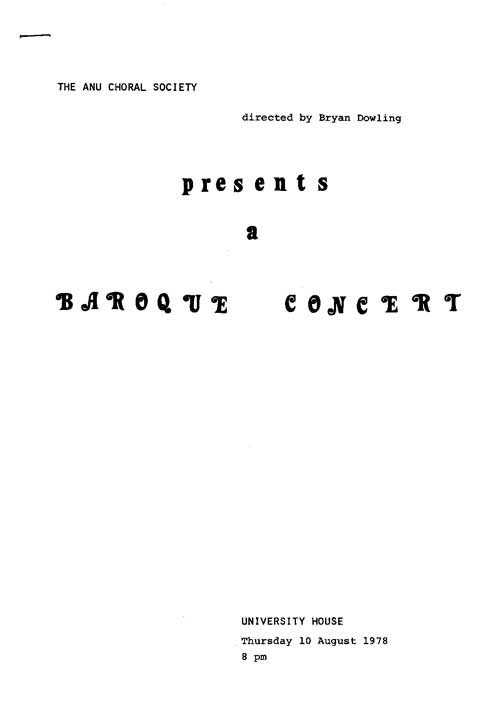
THE ANU CHORAL SOCIETY
directed by Bryan Dowling
presents
a
BAROQUE CONCERT
UNIVERSITY HOUSE
Thursday 10 August 1978
8pm
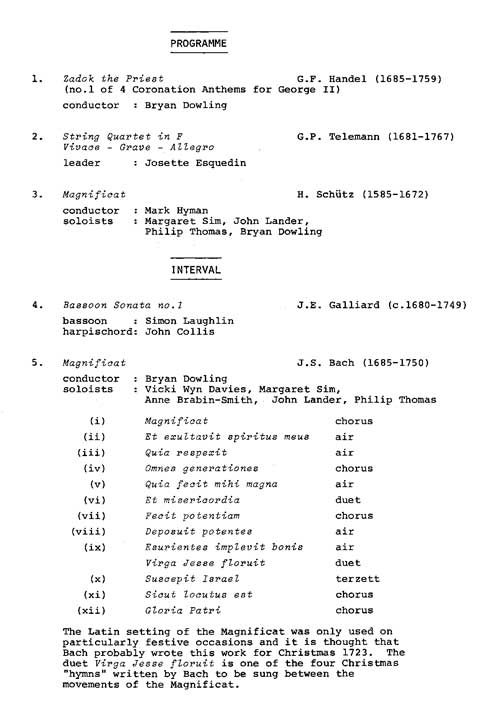
| ____________ PROGRAMME ____________ |
|||
| 1. | Zadok the Priest (no. 1 of 4 Coronation Anthems for George II) |
G.F. Handel (1685-1759) | |
| conductor: | Bryan Dowling | ||
| 2. | String Quartet in F Vivace - Grave - Allegro |
G.P. Telemann (1681-1767) | |
| leader: | Josette Esquedin | ||
| 3. | Magnificat | H. Schutz (1585-1672) | |
| conductor: | Mark Hyman | ||
| soloists: | Margaret Sim, John Lander, Philip Thomas, Bryan Dowling |
||
| _________ INTERVAL _________ |
|||
| 4. | Bassoon Sonata no. 1 | J.E. Galliard (c.1680-1749) | |
| bassoon: | Simon Laughlin | ||
| harpsichord: | John Collis | ||
| 5. | Magnificat | J.S. Bach (1685-1750) | |
| conductor: | Bryan Dowling | ||
| soloists: | Vicki Wyn Davies, Margaret Sim, Anne Brabin-Smith, John Lander, Philip Thomas |
||
| (i) | Magnificat | chorus | |
| (ii) | Et exultavit spiritus meus | air | |
| (iii) | Quia respexit | air | |
| (iv) | Omnes generationes | chorus | |
| (v) | Quia fecit mihi magna | air | |
| (vi) | Et misericordia | duet | |
| (vii) | Fecit potentiam | chorus | |
| (viii) | Deposuit potentes | air | |
| (xi) | Esurientes implevit bonis | air | |
| Virga Jesse floruit | duet | ||
| (x) | Suscepit Israel | terzett | |
| (xi) | Sicut locutus est | chorus | |
| (xii) | Gloria Patri | chorus | |
The Latin setting of the Magnificat was only used on particularly festive occasions and it is thought that Bach probably wrote this work for Christmas 1723. The duet Virga Jesse floruit is one of the four Christmas "hymns" written by Bach to be sung between the movements of the Magnificat. |
|||
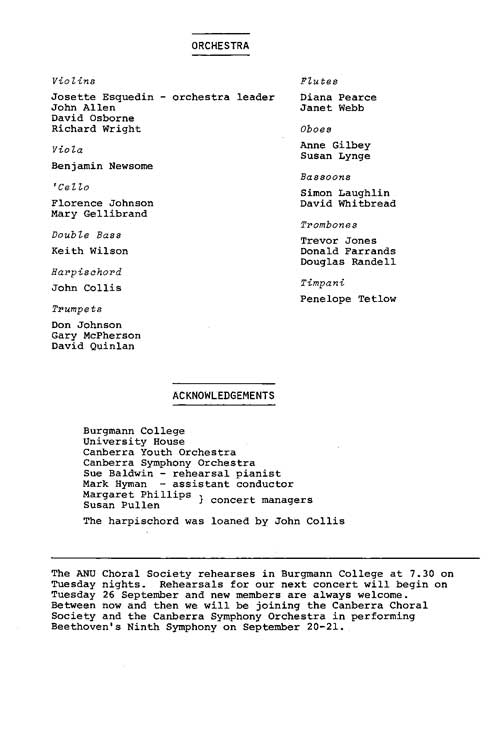
| ___________ ORCHESTRA ___________ |
|
| Violins | Flutes |
| Josette Esquedin - orchestra leader John Allen David Osborne Richard Wright |
Diana Pearce Janet Webb |
| Viola | Oboes |
| Benjamin Newsome | Anne Gilbey Susan Lynge |
| 'Cello | Bassoons |
| Florence Johnson Mary Gellibrand |
Simon Laughlin David Whitbread |
| Double Bass | Trombones |
| Keith Wilson | Trevor Jones Donald Farrands Douglas Randall |
| Harpsichord | Timpani |
| John Collis | Penelope Tetlow |
| Trumpets | |
| Don Johnson Gary McPherson David Quinlan |
|
_____________________
ACKNOWLEDGEMENTS
_____________________
Burgmann College
University House
Canberra Youth Orchestra
Canberra Symphony Orchestra
Sue Baldwin - rehearsal pianist
Mark Hyman - assistant conductor
Margaret Phillips) concert managers
Susan Pullen )
The harpsichord was loaned by John Collis
The ANU Choral Society rehearses in Burgmann College at 7.30 on Tuesday nights. Rehearsals for our next concert will begin on Tuesday 26 September and new members are always welcome. Between now and then we will be joining the Canberra Choral Society and the Canberra Symphony Orchestra in performing Beethoven's Ninth Symphony on September 20-21.
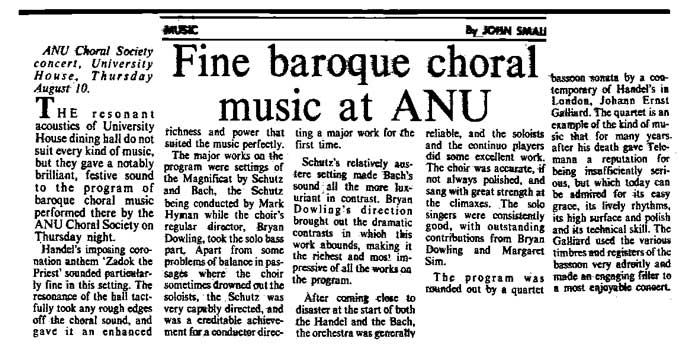
ANU Choral Society Concert, University House, Thursday August 10 [1978].
The resonant acoustics of University House dining hall do not suit every kind of music, but they gave a notably brilliant, festive sound to the program of baroque choral music performed there by the ANU Choral Society on Thursday night.
Handel's imposing coronation anthem 'Zadok the Priest' sounded particularly fine in this setting. The resonance of the hall tactfully took any rough edges off the choral sound, and gave it an enhanced richness and power that suited the music perfectly.
The major works on the program were settings of the Magnificat by Schutz and Bach, the Schutz being conducted by Mark Hyman while the choir's regular director, Bryan Dowling, took the solo bass part. Apart from some problems of balance in passages where the choir sometimes drowned out the soloists, the Schutz was very capably directed, and was a creditable achievement for a conductor directing a major work for the first time.
Schutz's relatively austere setting made Bach's sound all the more luxuriant in contrast. Bryan Dowling's direction brought out the dramatic contrasts in which this work abounds, making it the richest and most impressive of all the works on the program.
After coming close to disaster at the start of both the Handel and the Bach, the orchestra was generally reliable, and the soloists and the continuo players did some excellent work. The choir was accurate, if not always polished, and sang with great strength at the climaxes. The solo singers were consistently good, with outstanding contributions from Bryan Dowling and Margaret Sim.
The program was rounded out by a quartet bassoon sonata by a contemporary of Handel's in London, Johann Ernst Galliard. The quartet is an example of the kind of music that for many years after his death gave Telemann a reputation for being insufficiently serious, but which today can be admired for its easy grace, its lively rhythms, its high surface and polish and its technical skill. The Galliard used the various timbres and registers of the bassoon very adroitly and made an engaging filler to a most enjoyable concert.