
SCUNA history » Concerts » 1969 - 2
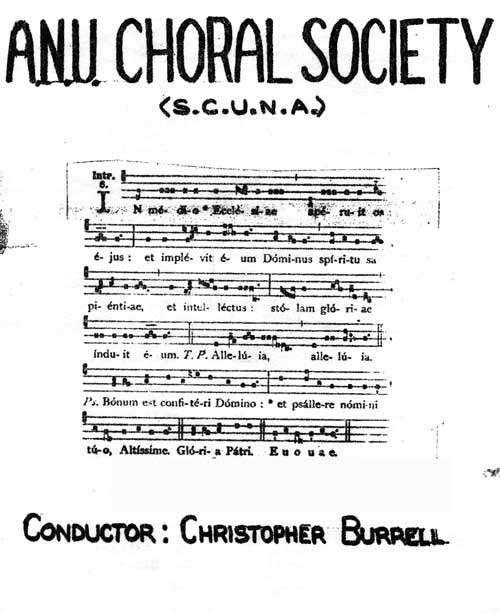
In medio Ecclesiae aperuit os ejus: et implevit eum Dominus spiritu sapientiae, et intellectus: stolam gloriae induit eum.
- Introit from the Gregorian setting of the Missa de Doctoribus
In the midst of the Assembly, wisdom opened his mouth, and the Lord filled him with the spirit of wisdom and understanding: He clothed him with a robe of glory.
[PROGRAMME]
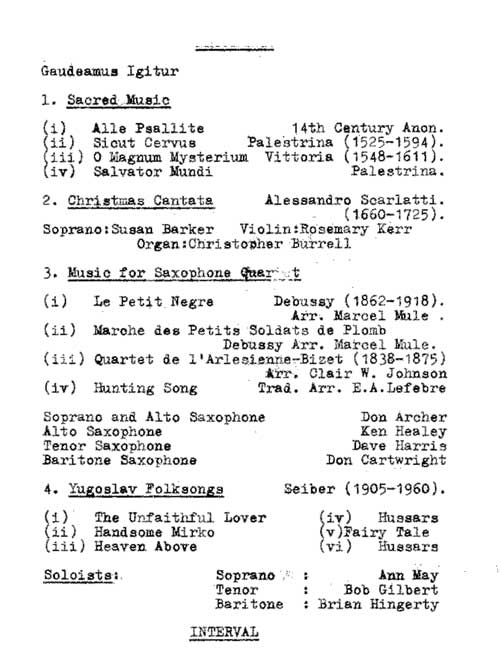
| Gaudeamus Igitur2 | |||
| 1. | Sacred Music | ||
| (i) | Alle Psallite | 14th Century Anon. | |
| (ii) | Sicut Cervus3 | Palestrina | (1625-1594) |
| (iii) | O Magnum Mysterium | Vittoria | (1548-1611) |
| (iv) | Salvator Mundi | Palestrina | |
| 2. | Christmas Cantata | Alessandro Scarlatti | (1660-1725) |
| Soprano: Susan Barker | Violin: Rosemary Kerr | ||
| Organ: Christopher Burrell | |||
| 3. | Music for Saxophone Quartet | ||
| (i) | Le Petit Negre | Debussy | (1862-1918) |
| Arr. Marcel Mule | |||
| (ii) | Marche des Petits Soldats de Plomb | Debussy | |
| Arr. Marcel Mule | |||
| (iii) | Quartet de l'Arlesienne | Bizet | (1838-1875) |
| Arr. Clair W. Johnson | |||
| (iv) | Hunting Song | Trad. | |
| Arr. E.A. Lefebre | |||
| 4. | Yugoslav Folksongs4 | Seiber | (1905-1960) |
| (i) | The Unfaithful Lover | (iv) | Hussars |
| (ii) | Handsome Mirko | (v) | Fairy Tale |
| (iii) | Heaven Above | (vi) | Hussars |
| Soloists: | Soprano | Ann May | |
| Tenor | Bob Gilbert | ||
| Baritone | Brian Hingerty | ||
INTERVAL
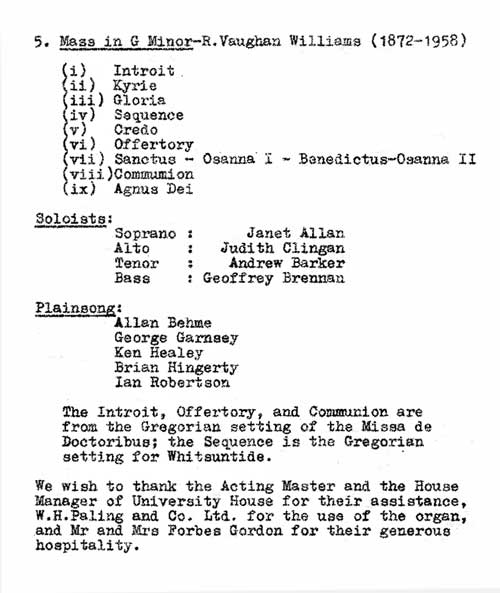
| 5. | Mass in G Minor | R. Vaughan Williams (1872-1958) | |
| (i) | Introit | ||
| (ii) | Kyrie | ||
| (iii) | Gloria | ||
| (iv) | Sequence | ||
| (v) | Credo | ||
| (vi) | Offertory | ||
| (vii) | Sanctus - Osanna I - Benedictus - Osanna II | ||
| (viii) | Communion | ||
| (ix) | Agnus Dei | ||
| Soloists: | |||
| Soprano: | Janet Allan | ||
| Alto: | Judith Clingan | ||
| Tenor: | Andrew Barker | ||
| Bass: | Geoffrey Brennan | ||
| Plainsong: | |||
| Allan Behme | |||
| George Garnsey | |||
| Ken Healey | |||
| Brian Hingerty | |||
| Ian Robertson | |||
| The Introit, Offertory, and Communion are from the Gregorian setting of the Missa de Doctoribus; The Sequence is the Gregorian setting for Whitsuntide. | |||
We wish to thank the Acting Master and the House Manager of University House for their assistance, W.H. Paling and Co. Ltd. for the use of the organ, and Mr and Mrs Forbes Gordon for their generous hospitality.5
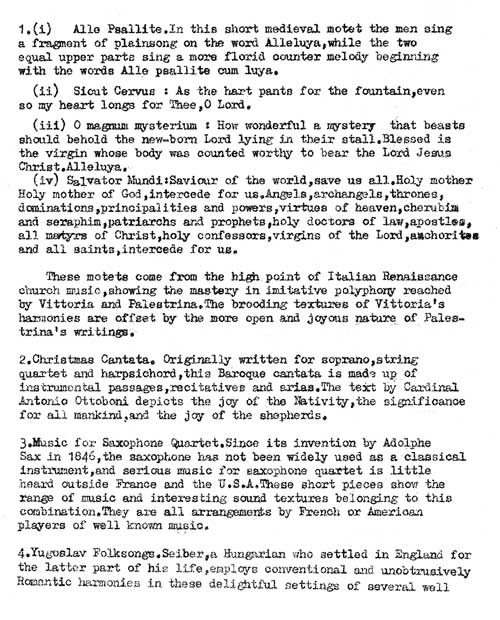
1. (i) Alle Psallite. In this short medieval motet the men sing a fragment of plainsong on the word Alleluya, while the two equal upper parts sing a more florid counter melody beginning with the words Alle psallite cum luya.
(ii) Sicut Cervus: As the hart pants for the fountain, even so my heart longs for Thee, O Lord.
(iii) 0 magnum mysterium: How wonderful a mystery that beasts should behold the new-born Lord lying in their stall. Blessed is the virgin whose body was counted worthy to bear the Lord Jesus Christ. Alleluya.
(iv) Salvator Mundi: Saviour of the world, save us all. Holy mother of God, intercede for us. Angels, archangels, thrones, dominations, principalities and powers, virtues of heaven, cherubim and seraphim, patriarchs and prophets, holy doctors of law, apostles, all martyrs of Christ, holy confessors, virgins of the Lord, anchorites and all saints, intercede for us.
These motets come from the high point of Italian Renaissance church music, showing the mastery in imitative polyphony reached by Vittoria and Palestrina. The brooding textures of Vittoria's harmonies are offset by the more open and joyous nature of Palestrina's writings.
2. Christmas Cantata. Originally written for soprano, string quartet and harpsichord, this Baroque cantata is made up of instrumental passages, recitatives and arias. The text by Cardinal Antonio Ottoboni depictrs the joy of the Nativity, the significance for all mankind, and the joy of the shepherds.
3. Music for Saxophone Quartet. Since its invention by Adolphe Sax in 1846, the saxophone has not been widely used as a classical instrument, and serious music for saxophone quartet is little heard outside France and the U.S.A. These short pieces show the range of music and interesting sound textures belonging to this combination. They are all arrangements by French or American players of well known music.
4. Yugoslav Folksongs. Seiber, a Hungarian who settled in England for the latter part of his life, employs conventional and unobtrusively Romantic harmonies in these delightful settings of several well [known folk tunes.]
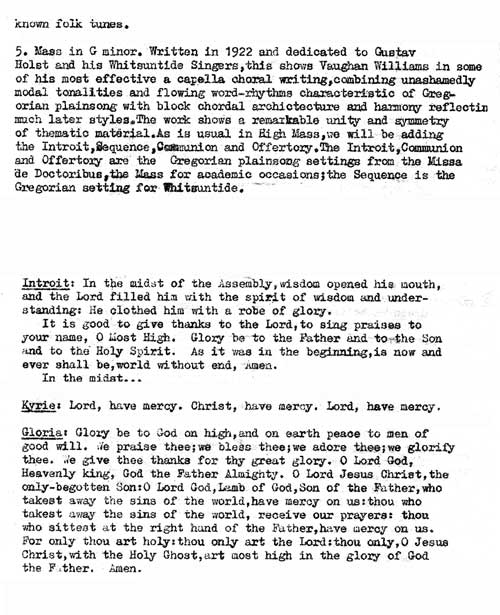
5. Mass in G minor. Written in 1922 and dedicated to Gustav Holst and his Whitsuntide Singers, this shows Vaughan Williams in some of his most effective a capella choral writing, combining unashamedly modal tonalities and flowing word-rhythms characteristic of Gregorian plainsong with block chordal architecture and harmony reflecting much later styles. The work shows a remarkable unity and symmetry of thematic material. As is usual in High Mass, we will be adding the Introit, Segqence, Communionn and Offertory. The Introit, Communion and Offertory are the Gregorian plainsong settings from the Missa de Doctoribus, the Mass for academic occasions; the Sequence is the Gregorian setting for Whitsuntide.
Introit: In the midst of the Assembly, wisdom opened his mouth, and the Lord filled him with the spirit of wisdom and understanding: He clothed him with a robe of glory.
It is good to give thanks to the Lord, to sing praises to your name, 0 most High. Glory be to the Father and to the Son and to the Holy Spirit. As it was in the beginning, is now and ever shall be, world without end, Amen.
In the midst...
Kyrie: Lord, have mercy. Christ, have mercy. Lord, have mercy.
Gloria: Glory be to God on high, and on earth peace to men of good will. We praise thee; we bless thee; we adore thee; we glorify thee. We give thee thanks for thy great glory. 0 Lord God, Heavenly king, God the Father Almighty, 0 Lord Jesus Christ, the only-begotten Son: 0 Lord God, Lamb of God, Son of the Father, who takest away the sins of the world, have mercy on us: thou who takest away the sins of the world, receive our prayers: thou who sittest at the right hand of the Father, have mercy on us. For only thou art holy: thou only art the Lord: thou only, O Jesus Christ, with the Holy Ghost, art most high in the glory of God the Father. Amen.
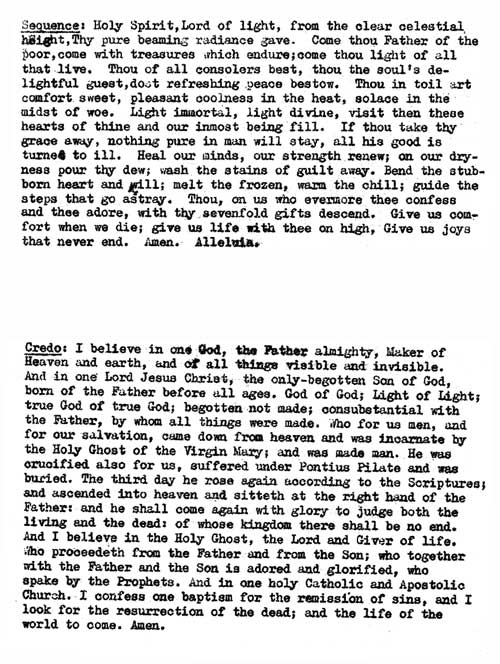
Sequence: Holy Spirit, Lord of light, from the clear celestial height, Thy pure beaming radiance gave. Come thou Father of the poor, come with treasures which endure; come thou light of all that live. Thou of all consolers best, thou the soul's delightful guest, dost refreshing peace bestow. Thou in toil art comfort sweet, pleasant coolness in the heat, solace in the midst of woe. Light immortal, light divine, visit then these hearts of thine and our inmost being fill. If thou take thy grace away, nothing pure in man will stay, all his good is turned to ill. Heal our minds, our strength renew; on our dryness pour thy dew; wash the stains of guilt away. Bend the stubborn heart and will; melt the frozen, warm the chill; guide the steps that go astray. Thou, on us who evermore thee confess and thee adore, with thy sevenfold gifts descend. Give us comfort when we die; give us life with thee on high. Give us joys that never end. Amen. Alleluia.
Credo: I believe in one God, the Father almighty, Maker of Heaven and earth, and of a11 things visible and invisible. And in one Lord Jesus Christ, the only-begotten Son of God, born of the Father before all ages. God of God; Light of Light; true God of true God; begotten not made; consubstantial with the Father, by whom all things were made. Who for us men, and for our salvation, came down from heaven and was incarnate by the Holy Ghost of the Virgin Mary; and was made man. He was crucified also for us, suffered under Pontius Pilate and was buried. The third day he rose again according to the Scriptures; and ascended into heaven and sitteth at the right hand of the Father: and he shall come again with glory to judge both the living and the dead: of whose kingdom there shall be no end. And I believe in the Holy Ghost, the Lord and Giver of life. Who prodeedeth from the Father and from the Son; who together with the Father and the Son is adored and glorified, who spake by the Prophets. And in one holy Catholic and Apostolic Church. I confess one baptism for the remission of sins, and I look for the resurrection of the dead; and the life of the world to come. Amen.
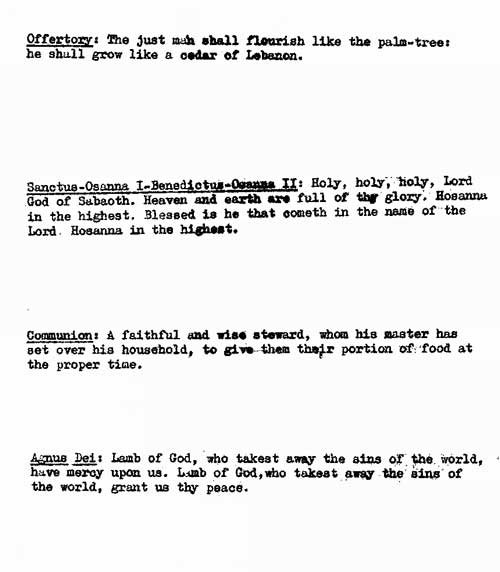
Offertory: The just man shall flourish like the palm-tree: he shall grow like a cedar of Lebanon.
Sanctus - Osanna I - Benedictus - Osanna II: Holy, holy, holy, Lord God of Sabaoth. Heaven and earth arefull of thy glory. Hosanna in the highest. Blessed is he that cometh in the name of the Lord. Hosanna in the highest.
Communion: A faithful and wise steward, whom his master has set over his household, to give them their portion of food at the proper time.
Agnus Dei: Lamb of God, who takest away the sins of the world, have mercy upon us. Lamb of God, who takest away the sins of the world, grant us thy peace.
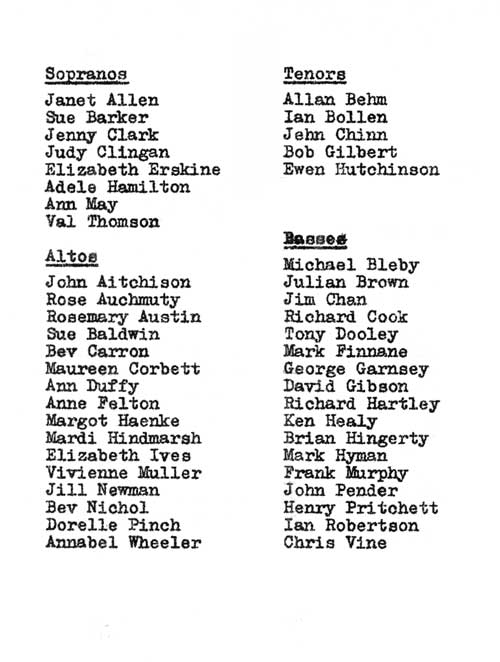
| Sopranos Janet Allen Sue Barker Jenny Clark Judy Clingan Elizabeth Erskine Adele Hamilton Ann May Val Thomson |
Tenors Allan Behm Ian Bollen Jehn Chinn Bob Gilbert Ewen Hutchinson |
| Altos John Aitchison Rose Auchmuty Rosemary Austin Sue Baldwin Bev Carron Maureen Corbett Ann Duffy Anne Felton Margot Haenke Mardi Hindmarsh Elizabeth Ives Vivienne Muller Jill Newman Bev Nichol Dorelle Pinch Annabel Wheeler |
Basses Michael Bleby Julian Brown Jim Chan Richard Cook Tony Dooley Mark Finnane George Garnsey David Gibson Richard Hartley Ken Healy Brian Hingerty Mark Hyman Frank Murphy John Pender Henry Pritchett Ian Robertson Chris Vine |
1I haven't covered up the stickytape marks on the programme cover. They were an integral part of the process we used - cut and paste, followed by making an electronic stencil. Very new technology in those days!
2In those days, SCUNA always opened concerts with Gaudeamus. (And SCUNA always wore academic gowns for concerts.)
3The first time Chris put the Palestrina Sicut Cervus in front of us (I believe it was at the end of a Sunday afternoon rehearsal) we stood up and sang it through without a hitch. For an unauditioned choir, this was an eerie and joyous feeling. Chris remarked later that the problem was to get us to do anything more with it, after that triumph.
4OK, I disliked this piece (I don't care for much after 1750, especially not folksy chromatic stuff!) but it provided a few laughs - for more information, see Note 1, Oyez July 1969 (Gilbert) and also Daryl C________'s Choral Mondegreens.
5They housed our all-day rehearsal in a large building which I think may have been a shearing shed on their property. I seem to recall that Ken was living in a cottage out there at the time.
An all-day rehearsal, out of town so people had to stay for the whole thing, was usually called when a concert was imminent. These rehearsals were gruelling but really important: it was wonderful to experience the progress that could be made with a whole day together. The mid-week lunchtime rehearsal was poorly attended, and not much more than a note-bashing session. And we had, I think, 1.5 hours on Sunday afternoons as well, sometimes with completely different personnel!